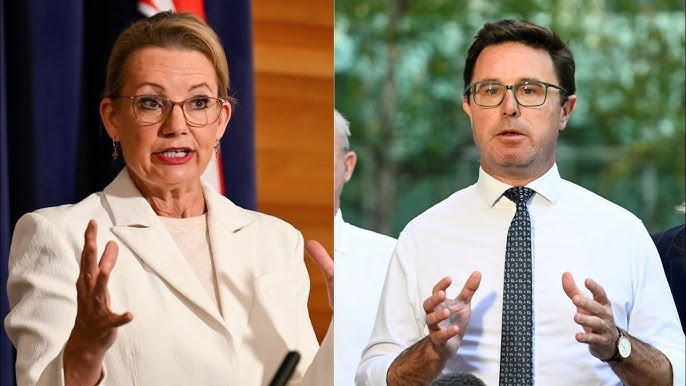
Greetings, all. I HAVE RETURNED . . . with more obscure Australian politics. I’m sure you are all just so excited!
Today we will be covering something that, to hear my grandparents describe it, “won’t stop taking up all the bloody slots on the ABC,” an analogy which I’m not going to even try to explain to an American audience, so just know it’s poignant. This ever-present topic is the current state and future of the Australian right wing and its politics as a whole. You see, after a bad election, a rising new party, and a fracturing coalition, things are looking quite uncertain. In this article, we will seek to cover what the Australian right has been doing, why it is reeling now, and what the actual heck is going on, because more news keeps dropping as I’m writing this to the point where even the parties themselves seem confused.
Background
All right, so for those (all) of you who are not connoisseurs of Australian politics, I will quickly cover how it works and the major parties. First off, like the USA, we have a House of Representatives and Senate, as well as a Supreme Court that establishes whether legislation is legal or constitutional. This is where the similarities end however, as we do not have a presidency. Our equivalent is a Prime Minister, but he is not elected separately by the people; instead he is given power by the ruling party or coalition of parties that band together to have a majority, and thus can form a government. There are a number of parties that exist and receive votes in Australia, but there are a few major ones.
First is the Greens, who are the most left-wing, push for environmentalism, and while a smaller party, still play a big role in government. Second is Labor, who are center-left and often fight for workers’ rights and unions and are the equivalent of the Democrats, as the largest single party. Third are the Liberals, who (different from the meaning of “liberal” in the USA) are center-right and the equivalent of the Republicans as the second-largest party. Next is the Nationals, who are a bit further right than the Liberals, and often focus on regional issues in rural areas and importantly are part of what’s known as the Coalition. What’s the Coalition? Well, it’s . . . a coalition between the Liberals and Nationals to form government together and work together, even combining the two into one party in some states. It has been in effect since 1923 and become a staple of politics in Australia. Lastly, there are some smaller parties, among which the most notable is One Nation, a populist right-wing party most akin to the MAGA movement in the USA.
Now that you have become a scholar in Aussie politics, we can get on and ask the question: what is actually going on that is causing these struggles? Well, there are three main things that have come up, so let’s go over each.
Situation 1: A Case Study in Polling Irregularities
It was early January, and deep in the Coalition super-secret base (location unknown, but probably somewhere in Benalla), a super-top-secret meeting was taking place. Peter Dutton (leader of the Liberal Party) and David Littleproud (leader of the Nationals) sat across from each other, dining while making small talk about the state of the country.
All of a sudden, a ministerial assistant ran in the room carrying stacks of paper and yelling, “Your Grace, the polling data is out!” Dutton grabbed the papers and slowly reviewed it. “What does it say?” Littleproud asked, picking his teeth with a wallaby bone and all of a sudden coughing up a ball of kangaroo fur. Dutton paused and said: “We’re still neck and neck.” You see, this was a big advancement since the last election, as the Liberals had been in government from 2013 to 2022 but had been kicked out of government by Labor.
“Don’t worry, Peter” Littleproud said. “Remember, Trump won!” You see, Dutton had been running a campaign based off that of Donald Trump, who had just won his presidential election in the USA that last November.
Dutton responded, “Yeah, everything will be fine!”
Fast forward to election night in May and . . . to put it lightly, they got thrashed. The largest Labour victory since World War II gave them 94 out of 150 seats in the House of Representatives (up from 77), while the Liberals and Nationals combined for only 43. Dutton himself, along with other high-profile Liberal leaders, lost his seat. All of this left the Liberal party scrambling to find new leadership.
Hours after the election, Littleproud returned to the Coalition base and walked into the meeting room.
“Well, Dutton,” he began, I know this looks bad, but jus—”
He quickly stopped in his tracks, and when he finally looked up at who was sitting in the room, he had only one question: “Who the heck are you?”
“Why, I am Sussan Ley, new Liberal party leader. Nice to meet you, Mr. Littleproud,” the woman replied.
Littleproud took a moment, calmly said “absolutely not,” and swiftly walked out.
This was the beginning of quite the tiff and the first major issue for the right: the failing Coalition. Between the election results they had just experienced and the change in leadership, the Nationals decided to withdraw from the Coalition, ending a decades-old alliance. They did quickly reform, but the Nationals made it very clear that they wanted a bigger role and that they were unhappy with leadership and policy. This came to the forefront again recently due to a new law regarding regulating hate speech. Multiple National senators rebelled against the Liberal-enforced Coalition support and voted against it. This triggered a crisis where Liberal leader Ley threatened their forced resignation, which led to another separation of the coalition. While this was saved by a last minute deal that brought the two together again, it shows that the traditional Coalition is weak and is even more liable to be threatened by other phenomena.
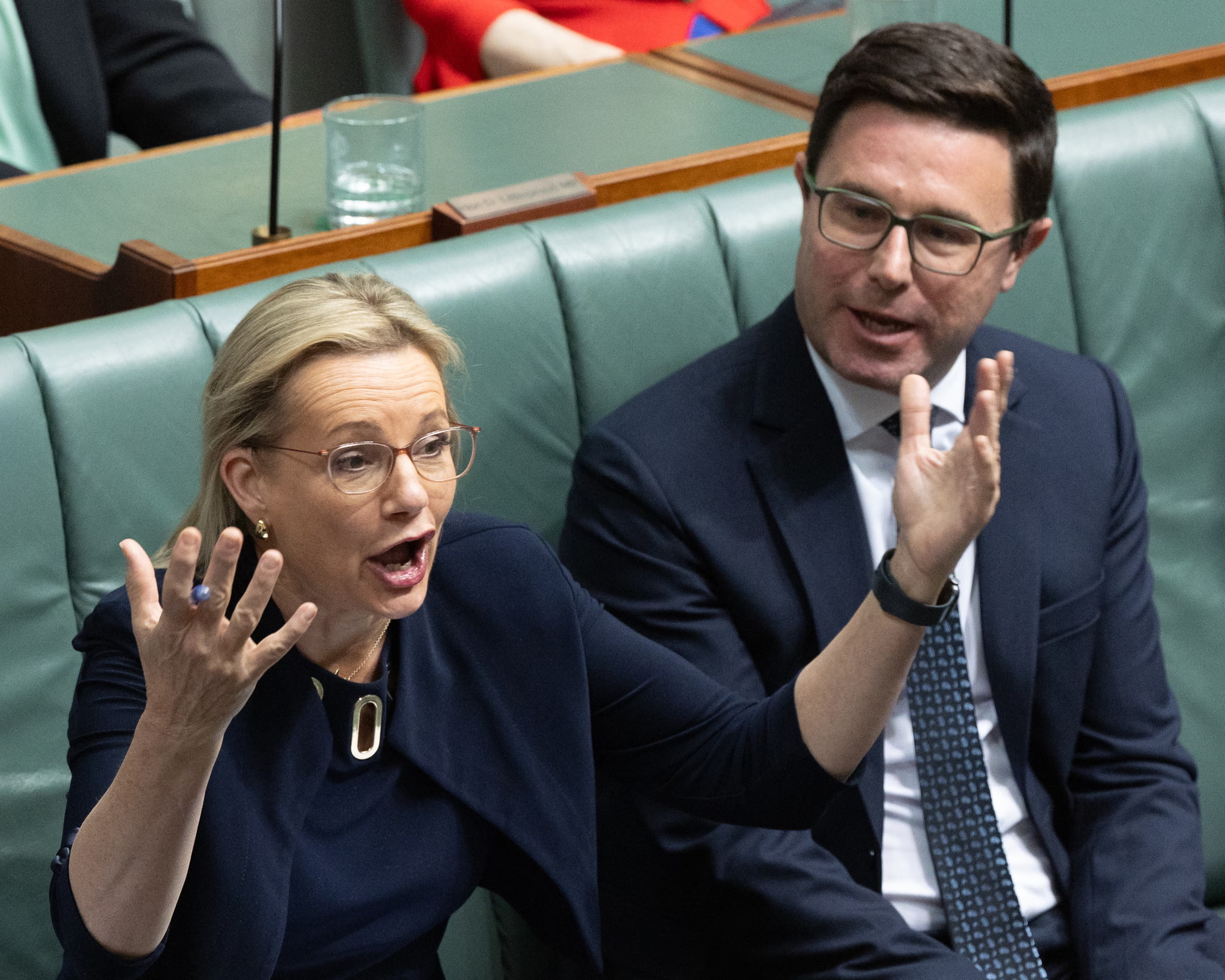
This is where our first problem would have ended. However, in response to this, the Liberal Party decided that actually Ley was not a good leader and also to blame for their bad polling numbers. There was another meeting in the super-secret Liberal base (location unknown, but probably somewhere near Benalla) where the party membership held a snap election to determine their new leader. After a few rounds of voting, there was a clear victor: MP Angus Taylor.
On hearing this, you may be asking “Who is Angus Taylor?” Well, he is the federal MP for Hume in New South Wales, but let’s really get down to it and ask not only who is Angus Taylor, but also: what is Angus Taylor? Where is Angus Taylor? How is Angus Taylor? And perhaps most importantly, why is Angus Taylor?
To get that information, how about we ask his former boss, ex-Prime Minister Malcolm Turnbull, in whose cabinet Taylor served. When Turnbull was asked about Taylor, he called him “The best qualified idiot he’d ever met.”
Ah, I see. Well, that’s not exactly flattering, but let’s take a look at his work in Hume. What has he actually done there? Here we are in for quite a treat. Imagine, if you will, Hume in 2019. It’s a prospering and rich electorate akin to the Garden of Eden, with beautiful sprawling gardens and joyous yobbos prancing outside of Penrith and Liverpool.
However in the neighboring Labor-controlled electorate of Lindsay, all was dreary, grey, and Communistically focused on public transit. Seeing this, Taylor decided to liberate this territory by going to a bordering train station and filming himself vehemently supporting his freedom-loving support for car parks! This statement, so perfect in its delivery, caused the heavens to open up with the roaring of angel trumpets and for Shakespeare to rise from his grave and weep. Once finished, Taylor published the video to his social media.
The comments quickly rolled in, thanking him for his insight, but one comment was particularly full of praise. It read “Fantastic. Great move. Well done Angus,” posted by one “Angus Taylor MP.” . . . yes, Taylor had in fact replied to his own video congratulating himself.

The other major thing he has accomplished is . . . oh, right! Getting involved with an alleged scandal to misuse government water funds to the tune of 80 million AUD, now known as Watergate. All of this is to prove that, despite this change, the Liberals are essentially in the same place, if not worse off. I would like to offer a comparison. This change of leadership is like changing one’s shirt after spilling hot coffee on one’s trousers. The shirt is fine and dandy, if a little dated, but the trousers are still soaked, they will still smell, and the third degree burns are still going to send you into shock.
Situation 2: Right Comes In, Right Goes Out
On top of a failing Coalition, there is another threat to the traditional right, which is . . . well, the right. You see, other than the Liberals and Nationals, there are other right-wing parties that have popped up and seek to claim more of the same voter base. A few examples include Katter’s Australian Party, the Jacqui Lambie Network, the United Australia Party, and One Nation. All of these have been around for a while, but attracted new attention after the 2025 election. These parties fill a political niche the Liberals have not: populism. To keep it simple, this would be the difference between older-school “establishment” and MAGA Republicans in the United States: the populists are generally further right. One Nation, under their leader Pauline Hanson, has had a rather explosive tenure as the major exponent of this populist current. They have quite ferociously fought for policies regarded as pro-business, anti-immigration, and climate denialist. However, they have been rather outlandish in their ways of doing this. In just one recent example, Pauline Hanson herself got suspended from the Senate for wearing a full burqa in a stunt to try and push for legislation to ban their use in public areas.
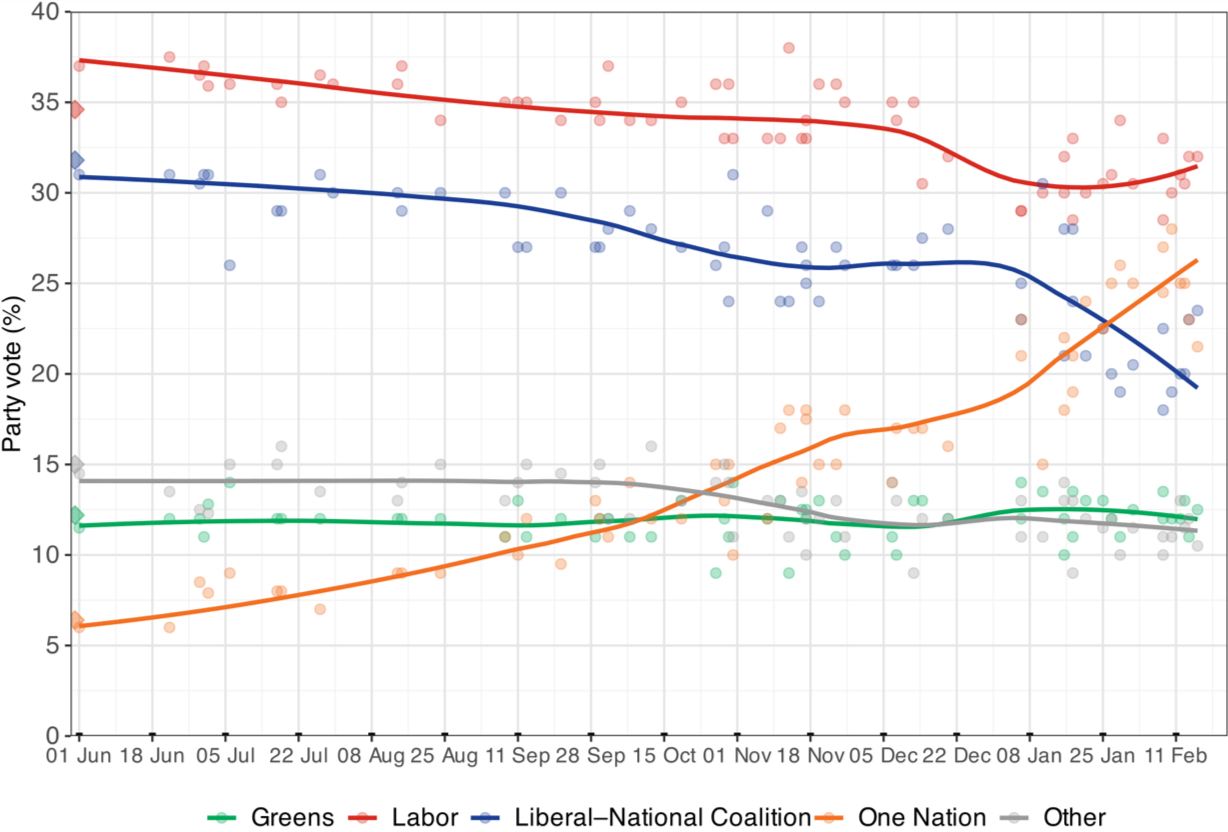
One Nation has traditionally been a rather fringe party, with currently only one seat in the House and three in the Senate. However, that may be changing. Recent polling from January 26th showed One Nation at 22.5% support, up from only 13.5% in December of last year. This new surge, which puts them only a few points behind the Coalition, can largely be attributed to a loss of confidence in the Coalition. After the aforementioned two breaks and the horrendous election performance, many voters are seemingly deciding to abandon the Coalition and move to One Nation. While the chance for One Nation to ever get into a major party position or form a government remains slim, due to the current support for Labor and this being the Coalition at their worst, let’s lay out the probable only way this could happen, just as a hypothetical.
First, One Nation would have to keep growing in support until it reaches around 30%, and hold it until the next election in 2028, which is already unlikely. Next, it would need to somehow gather more seats, which it would most likely do from the Nationals or Liberals, to secure government. This could really only happen in two ways: either a defection from the Nationals, or a tripartite Liberal-National-One Nation Coalition. The first choice would require the already weak Coalition to fully break and for the Nationals to instead form a coalition with One Nation, while the second would have the three parties all join in government together. In both cases, however, One Nation would once again need major support to stay in the fight and gain at least 20 seats. Any fewer than this, and it would mean they would be too insignificant to form part of any government.
Lastly, however, it would also require the incumbent Labor government and left-wing parties to throw away their own chances at government. This is quite unlikely, however, as even after a national crisis over gun laws following the 2025 Bondi Beach shootings and increasing global uncertainty, Labor is still polling at 56% and other left parties like the Greens still hold smaller but important voter shares.
Overall, the Australian right is currently reeling. Due to poor election performance, Coalition issues, and the rise of new parties, the future of these parties and their leaders is uncertain, to say the least. However all we can really do is hope for reason to prevail. Here’s hoping that whichever coalition or party ends up elected to government next, they will govern with care and responsibility. Thank you for reading, and I would strongly encourage you to read further outside this article.