
October: a month of scares and frights, with Halloween as the apex of this truly terrifying month.
That means it is time for my annual stupid Halloween article talking about the truly frightful parts of the United States political system. In this edition, we are talking about the . . . Supreme Court. *ghostly howl*
In specific, we will be going over two of the most dreadful, gut-wrenching, and possibly constitutionally-unsound cases currently before the Nine. So queue up Toccata and Fugue in D Minor, and let’s get to work.
Case #1: Conversion Mania (Chiles v. Salazar)
It was a (not at all) dark and stormy night in Colorado when, in the state capitol, a piece of legislation was passed. This was the bill known as *crack of thunder* HB19-1129 . . . bloody hell, they need to find some better names for legislation. I mean, I don’t know if I’m hurting their feelings with that last comment, but they didn’t even try with this one. Well despite its rather (let’s say) bland name, its topic is not. The bill bans the use of conversion therapy for minors in the state of Colorado.
Now you might be asking, “James, you witty and intelligent Shield columnist, what is conversion therapy?” Well, thank you for asking. Conversion therapy is a type of therapy which tries to change a person’s sexuality or gender identity. It is most commonly done by staunch Christians who see being gay or trans as a sin contrary to the Bible. Due to higher stigmatization of LGBT identities, conversion therapy was more popular in the past; however, even today, quite a few parents seek to send their children to these therapists. That may seem rather benign; however, we need to point out the dark side of this so-called therapy. It has been shown that conversion therapy causes significantly higher rates of depression and even suicide among its recipients. Beyond this, setting aside momentarily the question of whether the therapy would be worth it if it worked, as that ignores the humanity of those that go through it, there is also plenty of evidence that show it does not work. Most psychologists and other therapeutic practitioners consider it to be pseudoscientific at best.
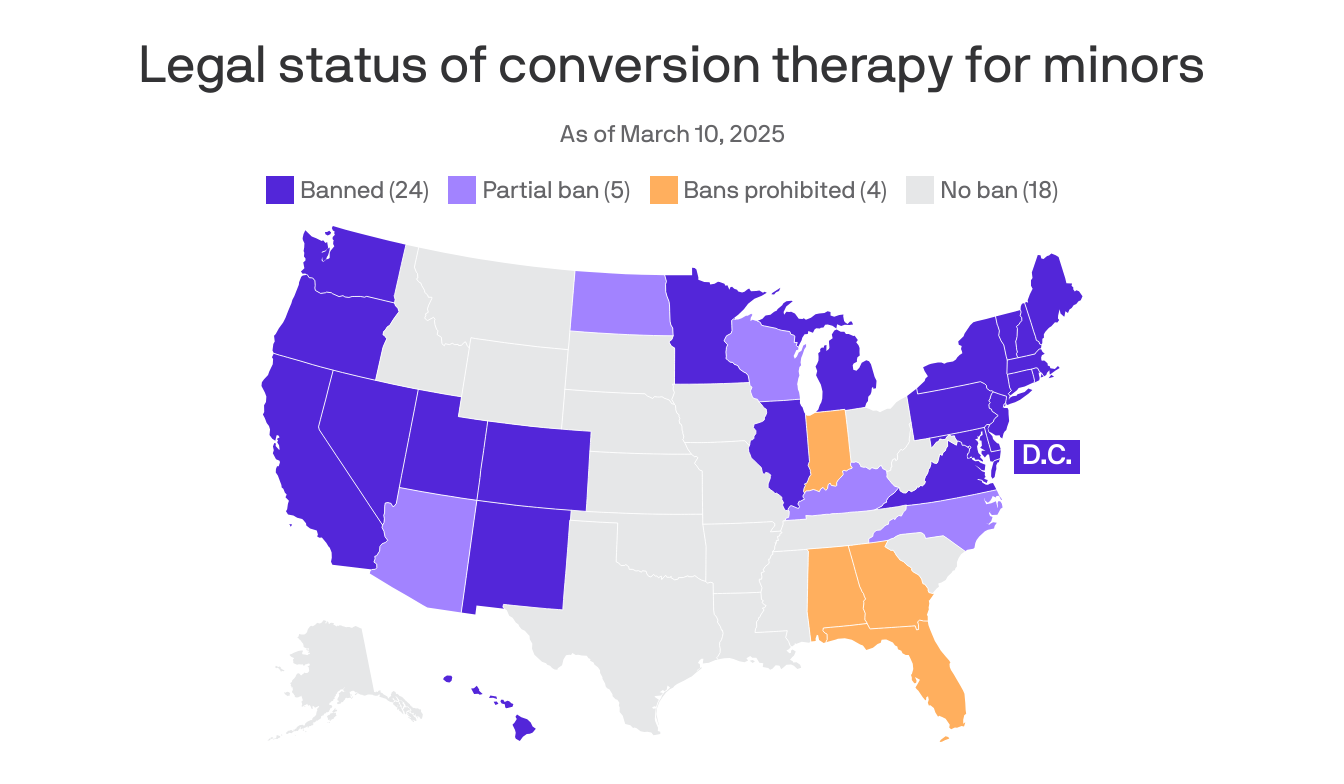
This bill, however, did anger a conversion therapist: one Kaley Chiles. After multiple appeals, her case went to the Supreme Court, to be eventually taken up and heard this year on October 7th. Its justification is that Chiles’ practice being banned is an obstruction of her free speech under the First Amendment.
Why mention this case on Halloween? It’s certainly rather freaky and scary, given that the highest court in the United States is taking a case with the potential to cause immense harm to an already vulnerable group of children. Keep in mind that if Colorado’s bill is overturned, a parent could essentially just send their kid off to be put through a non-scientifically sound so-called therapy that has numerous studies showing its active harm. To me, it is fairly scary that we can potentially overlook the preponderance of research and evidence and allow something despite it. For comparison, the Supreme Court has held twice that people’s speech can be restricted when it creates an imminent danger to others, so how is this, in its claimed justification of free speech, any different? In both examples we have a proven danger being caused by someone’s speech or actions, which led directly to their banning. *quack*
Roger, please, I told you to hit the button on the left. Stop messing up the damn sound effects. Now this just looks plain silly. One more and I’ll just do it myself! *indistinct noises like a Peanuts teacher talking*. . . That’s all right, Roger. Let’s just move on. Anyway . . . the Supreme Court year rolls on. *maniacal laughter* That’s more like it.
Case #2: Frankenstein’s. . . Bachelor? (Davis v. Moore)
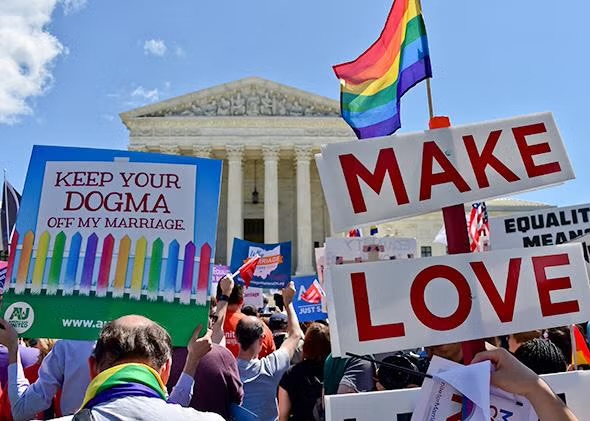
Our second case for the day, while not currently before the court, is an appeal up for consideration by the justices in November. It is regarding one of the scariest and spookiest things I may have ever heard of: gay marriage. *crack of thunder* This case concerns an appeal brought by Kentucky county clerk Kim Davis that explicitly asks the justices to overturn the famous Obergefell v. Hodges case, which legalized same-sex marriage at the federal level and required all states to recognize it.
This case had seemed to stand the test of time since its passage in 2015, but there is renewed pressure on the Supreme Court to change its decision, especially with a 6-3 conservative majority on the court. Most critiques of the case follow one of two avenues: judicial overreach, or overruling tradition/religion. The first group dislikes the ability of the Court to federalize issues and unilaterally redefine the definition of marriage to include same-sex couples. This is, however, a bit unfounded. First off, the Founders wanted the Constitution to change and adapt, so the definition of marriage expanding as time goes on is completely understandable and perhaps even intended. Second, however it is also the Court’s job to see if something needs to be federalized and controlled by different levels of government to abide by the Constitution; therefore it is exercising its right to enforce and define the Constitution. The second argument, more or less, holds that if cultural tradition or religious beliefs state that a certain practice should not be allowed, then it should not be allowed legally. First off, this is not based in any constitutional fact and is instead focusing on personal morals, but even then, this argument is flawed. Someone else having a same-sex marriage does not really infringe upon someone else’s right to religion; they are not being brainwashed by the government or mind-controlled by chemicals in the water supply, despite what some political pundits may somewhat similarly say. On top of this, time causes change: if tradition had been a barrier to changing any rights whatsoever, then women, people of color, and non-landowners would not be able to vote, which I’m sure a lot of people on either side of this debate can agree is not exactly logical. Tradition and culture changes as time goes on and therefore the law must change with it.
To me it is actually quite spooky that this is even being questioned. When we attempt to overturn basic rights and needs for people, especially those that are on the margins of society, that sets in motion a domino effect. We need to ask: where does the backlash stop? If marriage is not allowed, which is bad enough in itself, then what is next? Same-sex relationships? The ability to exist openly? The reinvigoration of Don’t Ask Don’t Tell? It is simply an unjustified demand that would rob people of their safety, liberty and ability to pursue happiness. It removes the flexibility and inclusivity that makes this nation so great. The United States’ strength has historically been that it welcomes, accepts, and fuses into itself the greatest aspects of everywhere around the world. Alienating people by taking their rights away will lead simply to stagnation. *quack*
Conclusion
OKAY, THAT’S IT, ROGER. GIVE ME THE SOUNDBOARD NOW! *argumentative trombone noises and door slam* Okay, this thing can’t be that hard to use.
*bang* *bonk* *maniacal laugh*
Oh, dear. Oh, no, the fog machine turned on. Okay, well that will have to be the end of our discussion today. Thank you fo—*alarm sound* *sprinkler system pouring water*
Oh bloody, the fog machine set off the sprinklers. Well thank you for read—*boom*—reading and please make sure to look further into these *thunder crack* issues.
Hap—*maniacal laughter*
Happy Halloween!