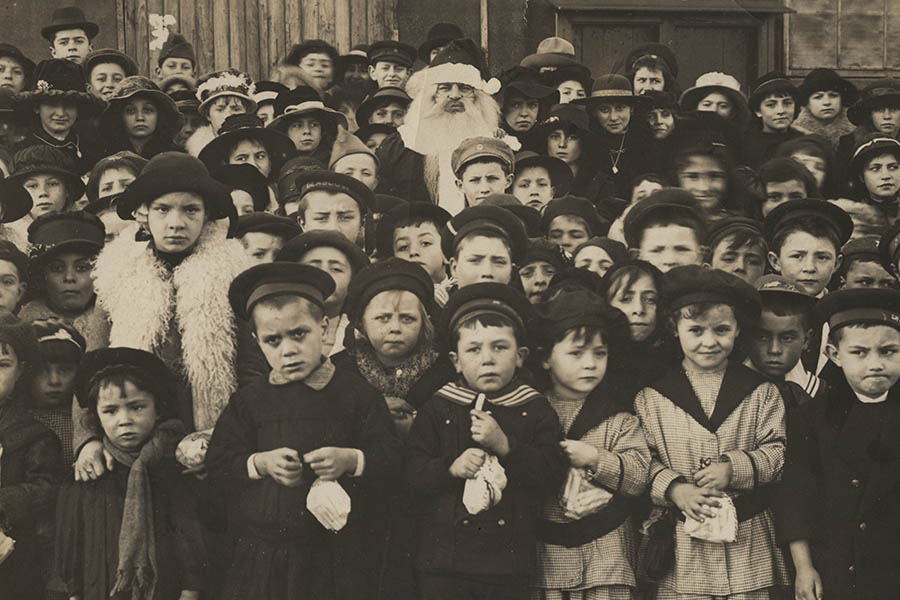
Ho, ho, hello everyone—and welcome to my interruption of your holiday cheer in order to give you information about a phrase for the ages: a tale of overconfidence, rallying nations, and a hint of superficial joy for good measure.
A phrase that is all too familiar when it comes to war: “We’ll be home by Christmas.”
It has been a constant for a long time, used as a great cop-out for generals and ministers of all nationalities, languages, and ages, these oft-uttered words have been a testament to humanity’s wishful thinking in history and war.
But how did it come about? Where did it begin? Why has it become a constant despite its usual failure?
Use in History
The phrase’s first use is incredibly hard to track down, but so far the earliest I have seen was its use by General George Washington in 1776, near the beginning of the Revolutionary War. He was convinced (as was much of the population) that the war would be quick, only lasting a few months and—therefore—as the all-too-infamous words would have it, it would be over by Christmas. It must be noted here that the war was, in fact, not over by Christmas of 1776, and went on until 1783, taking another seven Christmases until it was done.
After this, the words were not in the public mind and really didn’t come back into use until the 1860s, when the same phrase was used by the Union Army to rally their forces for the American Civil War. This was also an example of the phrase being inaccurate, as it was for another four years that the war went on.
Again there was a lull in its use, potentially due to this being the second time it failed in its validity, but “home by Christmas” came back into use in a big new way after the turn of the century. Here, we find probably one of, if not the most prevalent and notorious use of it: World War I.
The phrase was used on both sides, with the British using the words “It’ll be over by Christmas” to rally their population to arms, despite many in the General Staff knowing this would be a long war. The Germans used it as well, but in a more indirect way: when reviewing his troops, Kaiser Wilhelm II used the phrase “you will be home before the leaves fall from the trees” not directly referencing Christmas, but still implying the wintertime. Despite it coming close with the First Battle of the Marne (although the French may still not have surrendered had the Germans won), once again the phrase was wrong and the war continued on for four slogging, bloody years.
[Ed. Note—it should be noted that when the troops were not home by Christmas, a lot of them—to the chagrin and dismay of their superior officers—were surprisingly willing to make peace about it.]
It was sort of used in World War II, with songs like “I’ll Be Home For Christmas” and “Have Yourself a Merry Little Christmas,” but those are not really in the same context or framing of the topic at hand, so we will skip over this for the sake of an on-topic article.
The other contender for the most famous use of this phrase was during the Korean War, which saw theatre commander-in-chief and noted Bruce Willis lookalike Douglas MacArthur saying U.S. troops would be, you guessed it, “home by Christmas.” The difference in this example was that MacArthur genuinely, to our best thought, actually believed in his promise: the only thing that curtailed his quick war was the entry of the People’s Republic of China into the war, which dragged it on for another three years.
The words went missing during the Vietnam War, at least from officials’ mouths, but had a few appearances in the media during the invasion of Panama. Since then, there have been some limited uses of the phrase, though Iraq and Afghanistan being more occupations than wars somewhat weakened it. Now that we have seen just how many times it has been used and how long it has lasted, the question must be asked: why has it lasted so long and why is it used?
Reasons for Usage
The first main reason is simple: it is an effective way to rally a people to war. No one likes war, but they do like the prestige and the goals gained from war, so where does that leave the nation? How does it get the benefit of the outcome without all the death? It’s simple: make it quick.
If the nation can do that, and perhaps even win before a major holiday (wink, wink, nudge, nudge) no one will be missed and they will all come back fine, or at least that is how it can be framed. If the population is told “yes, the war will take four years and be an absolute slog,” as was known by General Kitchener and other British leaders before World War I, then no one would want in. No one wants to sign up for a deadly war, but a quick and simple one that will be done so the soldiers can go back to their families is much more likable.
It is also effective for raising morale during the war. As seen during the Korean War, if the population is told, “We are almost there; just keep going on without your loved ones for a little more,” they will be a lot more lenient towards the government than if they were told “your family isn’t coming back for years.” They won’t protest, they won’t object and just keep on going, as they know the war will end soon. It also reinforces the morale of the soldiers on the ground, as when they are in battle and want to get out of a place where they are being shot at and having their friends killed every day, if they are given hope and there is light at the end of the tunnel, there is more of an ability to fight on as there is a tangible goal in sight.
Another thing that must not be overlooked is the power of the word “Christmas” in the phrase. This is due to the fact that Christmas is not just a day: it is an experience. It is one of the best days for all, bringing people good memories of their family and friends, receiving gifts, and happiness. This remembrance brings them out of the current horrors on the field or tough times at home, giving them hope for not just normalcy, but a good and happy time to come. It stresses that the population will have their family members back in time for a celebration where that togetherness is a strong element and also one of the sorest spots for people missing them during war.
The last thing is it supports already existing nationalism, best seen in World War I. When a population believes in their nation and its greatness, it is easier to believe. At the time of World War I, Germany and Britain were both in a great age for them and still massive on the global stage, with worldwide prestige. This caused their populations to be very supportive and believe the phrase, as it was being said by the people who brought them to such great power. This makes the population really think that they will be able to be with their loved ones shortly, and they must just do some short-term sacrifices, with an emphasis on “short-term,” as when it gets to extreme or long-term sacrifices, these phrases fall through. If you look at Germany, when the blockades hit and Germans began to starve, the casualties mounted, and they still had not broken the West, the people lost faith and things like the Kiel Mutiny happened, which brought down the German monarchy.
The phrase exudes confidence for good and bad, for when you say those words, if they don’t come true, people become even more furious than they would have been in the first place. Just a few examples: the aforementioned Kiel Mutiny, protests against the Vietnam War, and other things of that sort happen, causing widespread hatred of the war. Even in the current day, despite the exact phrase not being used, we can still see parallels of these sorts of promises. The best current example of this is Vladimir Putin’s self proclaimed “three-day invasion” of Ukraine that is currently on 1,393 days as of this writing, with no real end in sight. There have also been parallels to German mutinies: regional areas in Siberia have seen civil revolt and disobedience, and in 2023 there was even a drive on Moscow by a PMC called Wagner, only to be barely stopped by a diplomatic scuffle that ended in its withdrawal. (Since then, much of Wagner’s leadership was killed in a plane crash.) Now there has not yet been a Kiel-Mutiny-style event, at least by the general population, due to a few things.
The first is that it’s a very tightly-run police state that has arrested a child before for as little as an anti-war drawing in crayon, so it is a bit hard to organize that without being pushed out a window or shot. It’s also due to the Russian people having a large amount of patriotism, due to a large amount of brainwashing and propaganda by the Russian government—for the past few centuries, really, but especially now. Lastly, it is also because they have not had enough hardship, as sure, a Kursk campaign, and sanctions are bad, but for Germany, it took literally being starved and millions to die for it to end, so in comparison it is not as bad for the people.
These phrases of overconfidence have shown themselves to be wishful thinking at most, and use the good memories of people to overshadow the bad of war. It is sad that people can so often fall into this belief that war can be won instantly with no repercussions, but people are usually somewhat brought to wake up and learn the hardship of war. This it is not to say that just because war is difficult, some (keyword: some) are not necessary, but blinding the population into this false belief is nothing but an irresponsible fantasy. Due to its usual effect, it may continue to be used, but people must see past its veil and realize that any phrase leading them to overconfidence in their nation needs to be observed with caution.